Project focus
CASE STUDY 03
Xiaohongshu AI Academic Tools Account | Content Operations from 0 to 2,580
Built an AI academic-tools content account from zero around paper writing, literature search, citation checks, and research-efficiency workflows, then shaped a repeatable matrix through topics, covers, scripts, and feedback review.
01
Project task
This project started from zero and built a Xiaohongshu account focused on AI academic tools.
The work went beyond posting: it required topic judgment, title and cover decisions, and a tight feedback loop from comments.
It is the clearest growth proof in the portfolio.
02
User problems and operating judgment
Problem
Pure feature introductions rarely perform well on a content platform.
Users engage more when the content is built around concrete tasks such as writing papers or checking citations.
Insight
Growth came from learning what users asked, saved, and discussed, not from posting volume alone.
The audience cared more about practical tasks and pitfalls than about broad tool overviews.
03
Operations strategy and content matrix
Organized the account around four repeatable content pillars based on real academic-user tasks.
Paper writing
Built content around outlining, drafting, revision, polishing, and tool-choice pain points.
Literature search
Covered problems such as finding papers, choosing keywords, and deciding on databases.
Citation checks
Focused on fake citations, citation validity, and source tracing.
Research efficiency
Covered tool scenarios around efficiency, organization, subscription, and reminders.
04
Content execution and real evidence
Shows only confirmed account screenshots and selected notes that can be matched to real source links.
Real account profile

The screenshot shows real account profile data; the numbers may continue to change.
Selected notes

Paper writingStrong hookContent expression
This is basically dark magic...
User question
Users do not know how to get into paper-writing quickly or which tools can actually help.
Short note
Uses a strong emotional hook to enter the paper-writing pain point and lower the barrier to understanding AI academic tools.

Paper workflowTool matchingScenario breakdown
Stop using AI blindly—pick the tool for the exact paper-writing stage
User question
Users are unsure which AI tool fits each paper-writing stage and tend to treat AI tools as one generic answer.
Short note
Breaks the paper-writing workflow into concrete stages and matches each stage with a fitting AI tool.
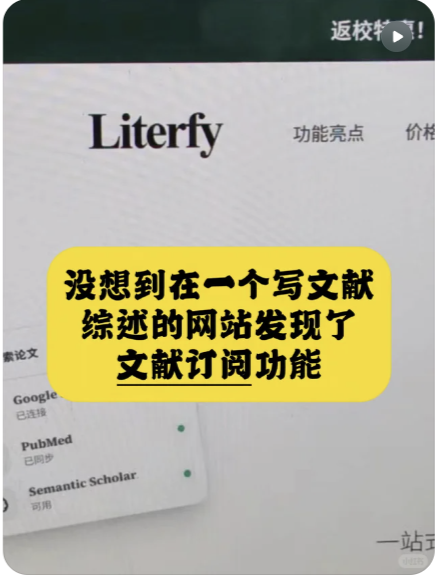
LiterfyLiterature subscriptionProduct translation
Didn’t expect to find a literature-subscription feature on a literature-review site
User question
When writing literature reviews, users want to track a research direction without repeatedly searching from scratch.
Short note
Turns Literfy’s literature-subscription feature into a concrete academic use case that users can understand quickly.
05
Feedback loop
Turn user feedback into the next round of topic decisions instead of only reviewing individual posts.
01
Publish
02
Collect comments
03
Sort user questions
04
Update topic pool
05
Adjust direction
How I handled feedback
I grouped comment questions by paper writing, literature search, citation checks, and tool choice, then added recurring needs into the next topic pool.
06
Results and next steps
Results
- Built an AI academic-tools vertical account from zero
- Grew the account to about 2,580 followers
- Formed a stable AI academic-tools content direction
- Built reusable topic-pool and feedback-sorting methods
Next step
- Add performance records for different topic types
- Turn recurring comment questions into content templates
- Improve publishing rhythm and review dimensions
- Continue collecting real user feedback